Roll-Up vs. Sectional Overhead Doors: Which Is Right for Your Facility?
Choosing the right commercial door for your facility comes down to how you operate. Both roll-up and sectional overhead doors are common solutions, but they serve different needs.
Understanding which commercial overhead door types fit your situation helps you avoid an expensive mismatch. Consider how often the door opens, how much space you have, whether you need insulation and your security priorities. This overhead door buying guide compares roll-up versus sectional garage doors across the most important factors to help you make the right choice.
What Is a Roll-Up Door?
A roll-up door has a curtain made of corrugated steel slats that coil into a compact drum mounted directly above the door opening. When you open it, the slats wrap around the drum. When you close it, they unroll.
The key advantage is space. Because no horizontal tracks extend back into your ceiling, you save significant overhead clearance. If you have ductwork, sprinkler systems or pallet racking, saved space matters.
Common applications for commercial roll-up garage doors include:
Self-Storage Units
High-Cycle Operations
Service Doors In Industrial Plants
Facilities With Limited Overhead Clearance
Roll-up doors are built for durability and high-volume use. They have fewer moving parts than sectional doors, which often translates to a longer lifespan in demanding environments.
What Is a Sectional Overhead Door?
A sectional overhead door consists of horizontal panels that are hinged together. The panels ride up on vertical tracks mounted to the sides of the door frame, then turn to run horizontally along the ceiling when fully open. Sectional doors can also use a vertical track configuration, which still requires more overhead space but allows the door to travel straight up until fully open or rise to the ceiling before turning horizontal.
These doors work well in several commercial settings:
Warehouses
Loading Docks
Retail Loading Areas
Automotive Service Bays
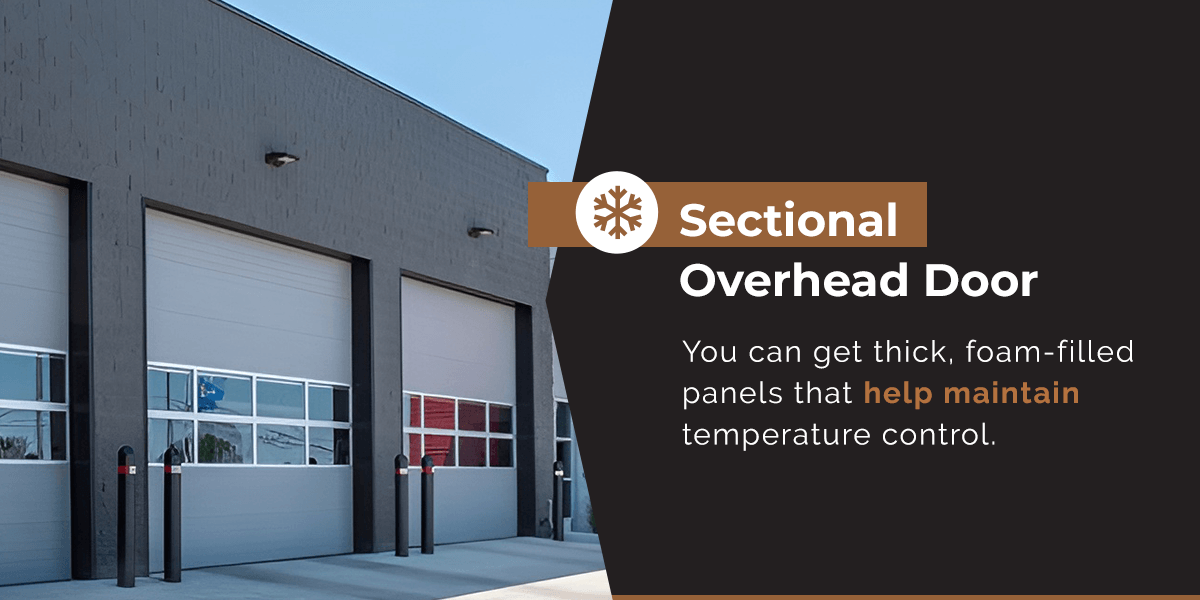
One of the biggest advantages of a sectional overhead door installation in a warehouse or other settings is insulation. You can get thick, foam-filled panels that help maintain temperature control, which matters if you're storing temperature-sensitive products or trying to keep heating and cooling costs down. You also have flexibility with design.
Roll-Up Door vs. Sectional Door: Head-to-Head Comparison
When comparing these doors, the decision is significantly determined by your specific operational requirements. Here's how they stack up across the factors that actually affect your day-to-day operations and bottom line.
Space Requirements
Sectional doors need room above and behind the opening. Standard configurations require enough depth for horizontal tracks to run along your ceiling, while vertical track setups run the door straight up before turning horizontal. Either way, sectional doors require more overhead clearance than a roll-up.
Roll-up doors require only enough space for the coiled drum above the opening. There are no horizontal tracks. If you're working with pallet racking or overhead obstructions like HVAC systems, or you want to maximize usable interior space, the compact footprint of a roll-up door is hard to beat.
Cycle Frequency and Durability
A cycle is one complete open-and-close sequence. If you're running a busy loading dock or a storage facility with constant access, cycle count matters.
Heavy-duty rolling steel doors are often engineered for 50,000 to 100,000 cycles or more. While roll-up doors do contain torsion springs, which are costly to replace, they have fewer moving parts compared to sectional doors. Fewer rollers and simpler mechanics overall translate to durability in high-traffic environments.
Standard sectional doors typically handle 10,000 to 25,000 cycles, though commercial-grade models can go higher. The trade-off is complexity. More parts mean more potential maintenance over time.
Insulation Options and Energy Efficiency
If temperature control is a priority, sectional doors have the edge. They typically offer superior insulation with thick, foam-filled panels. They also have a higher R-value, which measures thermal resistance. The higher the number, the better the insulation.
Sectional doors can reach R-values of 16 to 20 or higher for premium options, making them the preferred choice for climate-controlled warehouses, cold storage or any facility where you're paying to heat or cool the space.
Roll-up doors offer limited insulation options. Most models are single-layer steel, which offers little thermal resistance. Some manufacturers offer insulated roll-up doors, but they generally don't match the R-values of a well-insulated sectional door.
Security Level
Rolling steel doors provide a high level of security against forced entry. The continuous interlocking metal slats are difficult to pry open or breach. There are no individual panels to separate, and the compact coil design leaves little room for tampering.
Sectional doors offer solid security, but their paneled design can make them slightly more vulnerable. Individual panels are separated by hinges that can be targeted during a forced-entry attempt. For high-security applications like storage facilities, equipment yards or areas with valuable inventory, many facility managers choose roll-up doors.
Cost Range
Standard sectional doors often have a lower up-front cost, especially for basic models without heavy insulation or custom features. You can find entry-level commercial sectional doors at competitive prices.
Heavy-duty, high-cycle roll-up doors typically require a larger initial investment. The engineering, materials and durability built into these systems cost more up front.
When it comes to cost, you have to think in terms of long-term value, not just the initial price. If a roll-up door works with minimal issues, it can deliver better return on investment than a sectional door that needs spring replacements or track adjustments every few years. While roll-up doors are designed for durability, any necessary maintenance or repair can be more involved and costly.
Maintenance Requirements
Sectional doors have more moving parts. All of those components require regular maintenance, such as lubrication, tension adjustments and eventual replacement.
Roll-up doors have a simpler mechanism. Fewer parts mean fewer maintenance touchpoints. The coil system is straightforward. You'll still need routine inspections and lubrication, but the overall maintenance burden is typically lighter.
Key Questions to Ask to Guide Your Decision
Use these questions to help you decide between roll-up and sectional overhead doors based on your facility's specific requirements.
How Much Space Do You Have? Measure the space behind the door, and the space above and away from the opening, to determine which type of door is physically feasible and most efficient for your layout.
How Many Open/Close Cycles Per Day? If you're opening the door more than 20 times a day, durability and cycle count become critical factors.
Do You Need Insulation For Climate Control? If you're heating or cooling the space, calculate the energy cost savings of a well-insulated sectional door.
Is Security Or Speed Of Access A Higher Priority? High-security needs often favor roll-up doors, while sectional doors can offer faster operation with the right garage door opener system.
What's Your Long-Term Budget? Consider the total cost of ownership and the initial price, as well as the potential for involved and costly maintenance or repairs and energy costs over time.
The right choice depends on how you weigh these factors. There's no universal “best” option when comparing roll-up doors versus sectional garage door systems. It all comes down to the best fit for your specific operation.
Why Work With a Local Commercial Door Specialist?
Making the right choice between roll-up and sectional garage doors is easier when you partner with someone who understands your local building requirements and can assess your facility in person. A local commercial door specialist brings hands-on experience evaluating clearance and operational needs and the specific challenges your building presents.
Professional installation also matters. A door that's not properly installed won't perform to spec, no matter how good the product is. You also want a partner who can provide ongoing service when you need repairs or routine maintenance. Smoker Door Sales offers local expertise throughout Lancaster and Chester County, helping facility managers make informed decisions and providing reliable service long after installation.
Get Expert Help Choosing the Right Commercial Door for Your Facility
Whether you're comparing specific door types or need help figuring out what works for your building, Smoker Door Sales brings local expertise to PA and the surrounding area.
We assess your space, how you use it and your budget to recommend what actually makes sense for your operation. We provide an experience that's More Than A Door: professional installation, straight answers and reliable service when you need it.
Ready to make a confident decision? Contact Smoker Door Sales today for a personalized consultation and an expert recommendation built around your facility.